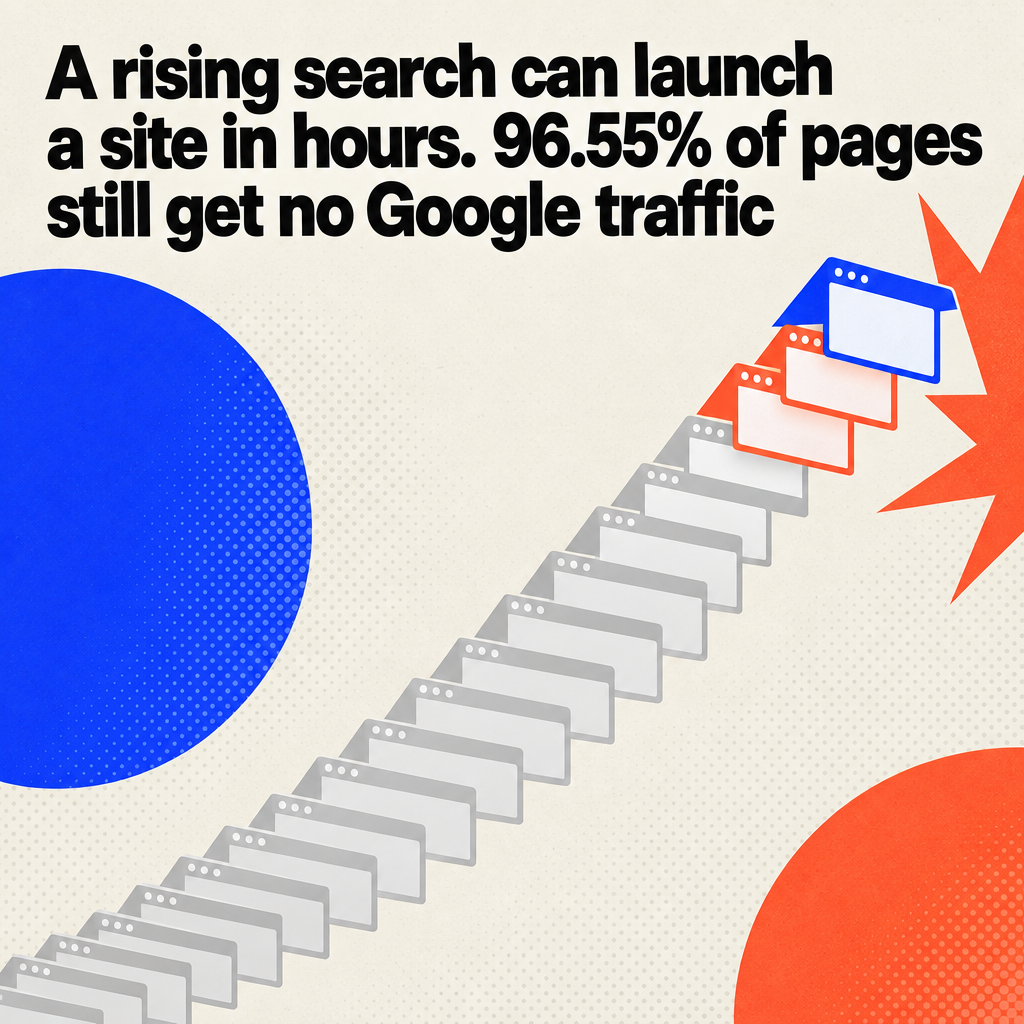
Building small sites around Google Trends keywords is a popular cold-start playbook for indie developers. Spot a query that's climbing fast, then ship a simple tool page within hours. Speed gets you in the door, but links and genuine usefulness decide whether you stay. When Ahrefs analyzed about 14 billion pages in 2023, 96.55% got zero traffic from Google.
The playbook is popular on social media, usually wrapped in slogans about choosing well mattering more than working hard. The first half of that is right: start from what people are searching for, not from an idea. But a few steps matter more than the slogans, and a few common tactics run straight into Google's spam policies.
Start from rising queries, not from ideas
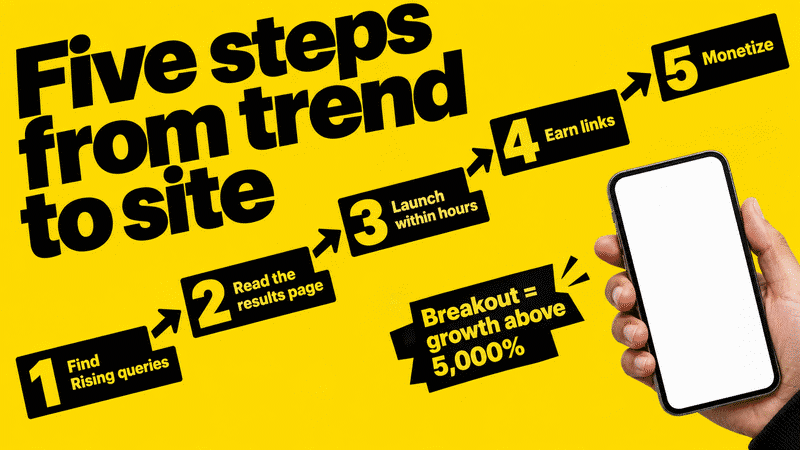
Google Trends lets you sort related queries by Rising. According to Google, those are the terms with the most significant growth in the selected period. When a query shows Breakout instead of a percentage, it grew by more than 5,000%, which usually means it's new or had almost no volume before.
A common routine is to set the region to worldwide and the period to the past seven days, then watch for terms climbing quickly from the second page. Once you find a batch, search each one again as a new seed to dig out longer, less competitive queries with clearer intent.
When nothing is breaking out, seed-keyword patterns fill the gap. Tool searches tend to follow fixed shapes:
| Pattern | Examples | Typical monetization |
|---|---|---|
| Feature + generator | bio generator, palette generator | Ads, credits |
| Format A to format B + converter | webp to png, pdf to docx | Ads, light subscriptions |
| Industry + calculator | cagr calculator, macro calculator | Ads |
| Known tool + alternative | notion alternative, canva alternative | Affiliate, subscriptions |
| Game name + online, wiki or tools | Browser games | Ads |
Read the results page before you build
Don't buy a domain yet. Search the term and study the first two pages.
Three signals suggest an opening. Results are mostly forum threads from Reddit or Quora, with no page built to solve the problem. The official or leading site is new and weak. The main domain extensions are still available.
Some signals mean walk away. You can't tell what the term means, the business is complex, there's legal exposure, or it has nothing to do with what you can deliver. Chasing trending brand names or adult-adjacent terms can also create trademark and platform-policy problems.
If you want numbers, Ahrefs and Semrush report monthly search volume, keyword difficulty (KD) and cost per click (CPC). Many indie builders treat a KD under 10 as the ceiling for a new site. Ahrefs also offers a free keyword difficulty checker, which together with Google's Keyword Planner covers most early needs.
Ship fast and keep infrastructure cheap
A trending term's window may last only days. Spend two months choosing a framework and polishing design, and it's gone.
Match the domain to the core keyword and prefer .com. If it's taken, try .net or .app, or add a hyphen or a modifier. After the first site, turn its responsive layout, multilingual SEO tags, sign-in and payments into a template, so the next site is a copy and rewrite.
Hosting can be close to free. Cloudflare's Workers Paid plan costs $5 a month, includes 10 million requests and charges nothing for egress. If you need a database, a serverless Postgres service such as Neon usually covers an early tool site on its free tier. Setting up Google Search Console, GA4 and Clarity is now a task you can hand to an AI coding assistant.
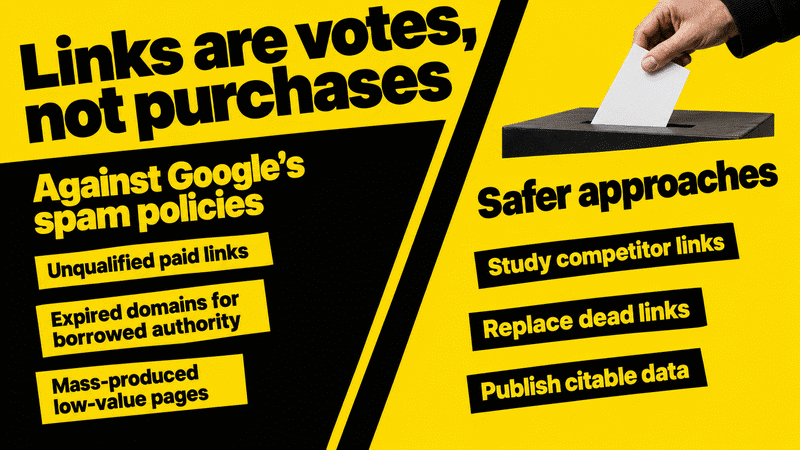
Scale is where this gets risky. Google's spam policies treat generating many pages primarily to manipulate rankings, without value for users, as a violation, and they name generative AI used that way. Reuse templates, but make sure each site actually solves a problem.
Links decide who stays on page one, and bought links break the rules
New sites often rank, then slide. When two sites target the same term with similar content, the one cited by more trustworthy sites usually wins. Think of backlinks as votes from other sites.
Early on, submit the tool to product directories and AI tool lists such as Product Hunt, There's An AI For That and Futurepedia. Write how-to guides on Medium or Dev.to, and share genuinely useful posts in relevant subreddits. Pace matters less than quality; a few solid links a week look more natural than a single burst.
Paid links are the trap. Google's spam policies say plainly that exchanging money, goods or services for links to manipulate rankings is link spam. Paid links need a rel="sponsored" or rel="nofollow" attribute. Buying guest posts or cheap bulk links risks demotion for the whole domain.
On March 5, 2024, Google announced three more spam policies covering scaled content abuse, site reputation abuse and expired domain abuse. The expired domain policy took effect on May 5, 2024. Buying an expired domain to borrow its old authority for unrelated content is exactly what it targets.
Three approaches hold up better. Study where the top three competitors earn their links and reach out to those sites. Find dead tool links on authoritative blogs and suggest yours as the replacement. Or publish a dataset or free utility that other writers want to cite.
Monetization, and what to avoid
| Direction | Revenue model | Tradeoff |
|---|---|---|
| Browser game information sites | Ads | High traffic, fastest first dollar |
| Utility tools | Credits, light subscriptions | Steady demand, ongoing maintenance |
| AI tools | Subscriptions, credits | Higher revenue per user, fiercest competition, API abuse risk |
Some online advice also recommends top-up reseller sites, or game sites that help students get around school network blocks. The first raises payment-compliance and supplier risk. The second can breach ad network and school acceptable-use policies. Both are worth skipping.
AI tool sites carry one more cost that's easy to miss. A leaked or abused API key can run up a bill overnight, so put rate limits and a server-side proxy in place before launch.
Who this playbook fits
It fits solo builders who want to validate a need cheaply and see a first dollar quickly. It fits poorly for companies building a long-term brand, B2B services or regulated industries, which depend on durable content and trust. Trend traffic arrives fast and leaves just as fast.
Running the full loop once still pays off. Keyword research, launch, analytics, links and monetization all produce real data, and the next site's decisions get faster.
Frequently asked questions
What does Breakout mean in Google Trends?
Google says that when a related query shows Breakout instead of a percentage, the term grew by more than 5,000% in the selected period. It usually signals a new term or one that previously had very little search volume.
How low should keyword difficulty be for a new site?
There's no official threshold. Many indie builders use an Ahrefs KD under 10 as the ceiling for a new site, since those terms can often rank with only a few links. The actual competitors on the results page still matter most.
Does Google allow buying backlinks?
Under Google's spam policies, exchanging money or services for links to manipulate rankings is link spam. Paid links are acceptable when they carry a rel="sponsored" or rel="nofollow" attribute.
Is it risky to clone many sites from one template?
Yes, at scale. Google treats generating many pages without value for users as spam, including pages mass-produced with generative AI. Templates are fine as long as each site genuinely solves a searcher's problem.
Sources
- Google Search Central: Spam Policies for Google Web Search
- Google Search Central: What web creators should know about our March 2024 core update and new spam policies (March 5, 2024)
- Google Trends Help: Find related searches
- Ahrefs: 96.55% of Content Gets No Traffic From Google (2023)
- Cloudflare: Workers Pricing
Author Insight
When I look at a new site, I check for a second reason to come back before I look at how fast it launched. Trend traffic fades. What tends to last is a tool that's genuinely useful and other sites willing to link to it. Speed wins you the spot; links and the product decide how long you keep it.