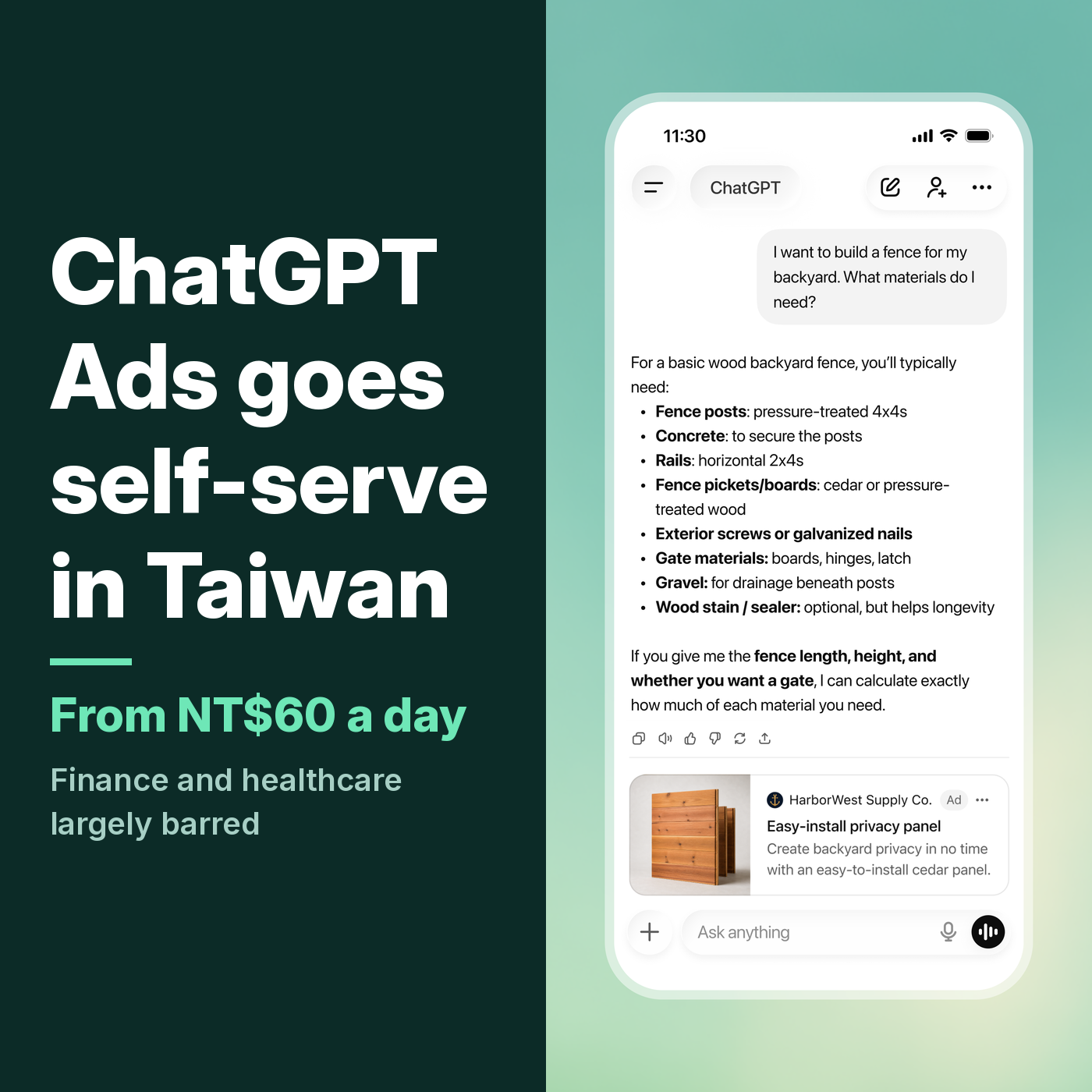
ChatGPT Ads is now open to businesses based in Taiwan, which can self-serve through Ads Manager. OpenAI began the rollout on September 23, 2026. The minimum daily budget is NT$60 for accounts billed in New Taiwan dollars. Ads appear only to users on the Free and Go plans, while Plus, Pro, Business, Enterprise and Edu accounts see none. Outside the United States, ads for financial, health and legal services are generally prohibited.
OpenAI announced the Taiwan launch alongside six Southeast Asian markets: Indonesia, Malaysia, the Philippines, Singapore, Thailand and Vietnam. ChatGPT Ads now runs in more than 60 countries. Large advertisers can work through OpenAI's Ads Solutions team, agency partners or technology partners, and eligible businesses can self-serve through Ads Manager.
The business is young. Ad testing began in the United States on February 9, 2026. At the end of August, OpenAI said ChatGPT Ads had reached a $1 billion annualized revenue run rate in under 200 days, and tens of thousands of advertisers now run campaigns. OpenAI's help center still calls the platform a beta: a pilot ran from February through April, self-serve onboarding came after, and delivery and spend may fluctuate. Everything below reflects OpenAI's documentation as read on September 30, 2026.
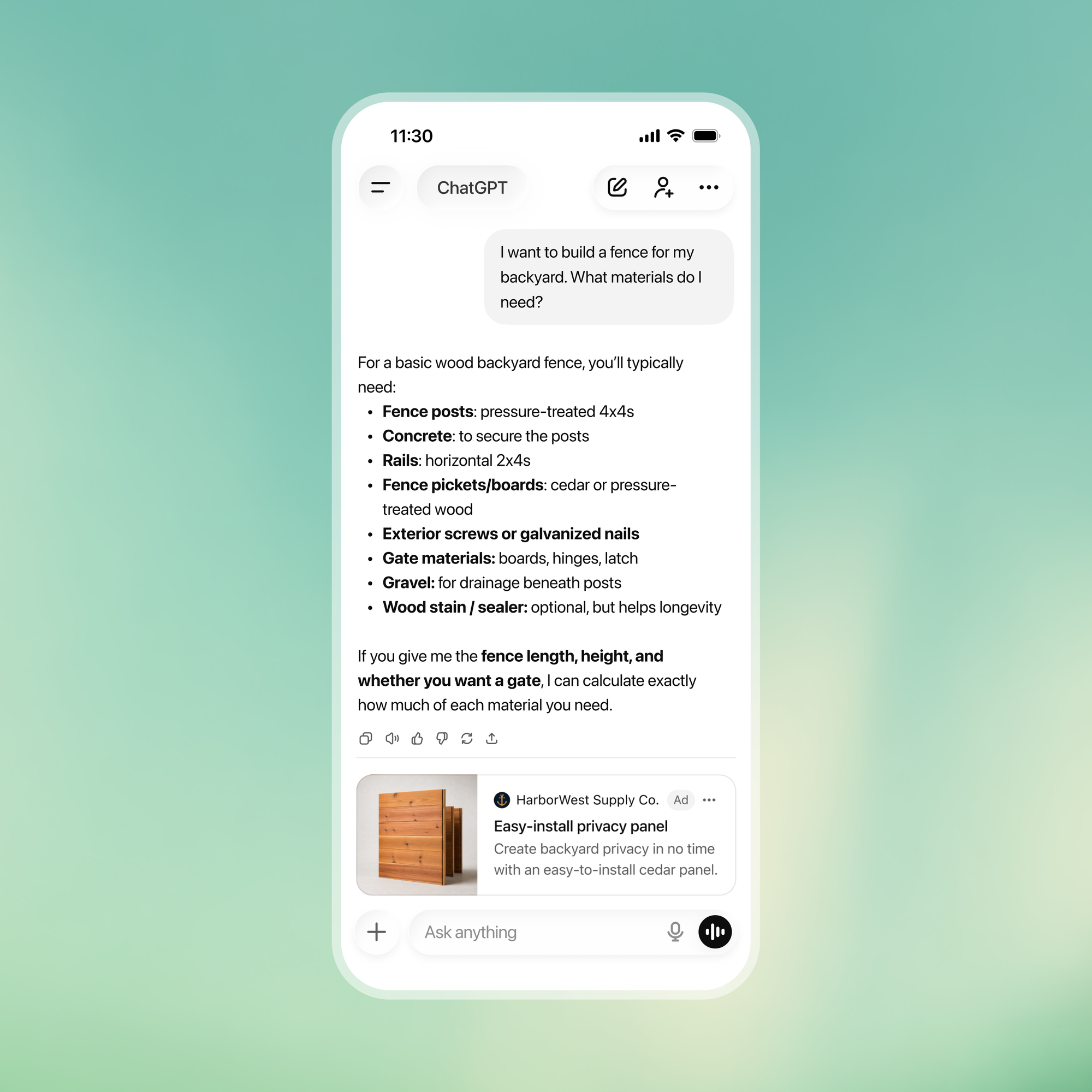
Who sees the ads
Ads sit below ChatGPT's answers, labeled as ads and kept separate from the response. Each unit carries an advertiser name, a favicon, a headline, a description, a landing page and an image. OpenAI's ad-unit diagram suggests aiming for about 16 characters in the headline and 32 in the description, and avoiding a logo as the main visual.
Reach is narrower than the user count suggests. Only Free and Go users see ads. Plus, Pro, Business, Enterprise and Edu accounts do not, and neither do accounts the system judges to belong to people under 18, Temporary Chats or, during the test, the ChatGPT Atlas browser. Ads also stay away from conversations about personal health, mental health and politics. Free users can switch to an ad-free mode in exchange for lower message limits and fewer tools, so the addressable audience is smaller than the Free user base.
The system weighs the context and intent of the current conversation, the ad's landing page, headline and copy, and the context hints an advertiser adds at the ad-group level. With personalization and memory both on, it can also draw on past chats and memories. Eligible ads compete in a relevance-weighted second-price auction.
Advertisers do not receive users' chats, chat history, memories, names, emails, precise location or IP addresses. They see aggregate results such as impressions and clicks. Users can turn off personalization, dismiss an ad, see why it appeared or clear their ad data in Settings under Ad Controls.
Who can open an account, and what can run
Self-service requires that the legal entity that will advertise and be billed is based in a listed country, and Taiwan is on the list. The country or region, currency and time zone chosen at signup cannot be changed afterward. Billing must be complete before any campaign delivers: a business profile with a name, address and invoice email, plus a credit card. OpenAI says the card should match the entity and country used at signup and that a card from another country may not be accepted. Adding a card can leave a temporary authorization hold visible for eight days or longer.
Some new self-serve accounts can advertise only in their home country at first. They become eligible for other supported countries after identity verification and a required amount of spend at home, and creating a campaign or setting a budget does not count. A brand that wants Taiwanese reach from an account based elsewhere should plan for that warm-up.
Category rules come next. OpenAI's ad policy, version 1.6 as of September 2026, says the test is primarily limited to consumer categories such as lifestyle and household goods, local services, travel and experiences, and digital products or education. Other categories are disallowed at launch, including dating and sexual content, alcohol and drugs, gambling and political content. The named list is illustrative, so an advertiser in a category that is not on it should submit for review and see what comes back. Financial, health and legal services are generally prohibited outside the United States, and the case-by-case exceptions in the policy apply to the US.
Creative, images and landing pages must agree end to end. The policy's own example is a food-delivery ad that links to alcohol delivery, which is rejected. General health and wellness products with no medical claims may be allowed, while treatment claims are restricted and health services are generally barred outside the US.
Landing pages carry a technical requirement as well. OpenAI reviews them with crawlers, and the site must allow OAI-AdsBot; OAI-SearchBot is recommended. Robots.txt rules, firewalls, bot protection and human-verification challenges can each block the crawler. OpenAI says Cloudflare has verified and allowlisted OAI-AdsBot, though a site's own rules still need checking. Ads or landing pages the system cannot review are not eligible to run, and OpenAI advises against expecting a manual bypass. After access is fixed, ads may need to be resubmitted. We would check crawler access first, because the fix usually sits with a site's firewall or bot-protection settings rather than the ad account.
How campaigns, bids and budgets work
Ads Manager has three levels. A campaign sets the objective, budget, dates and countries, and can target platforms such as mobile apps or desktop web. An ad group organizes ads by theme or customer need and holds the context hints. An ad is the headline, description, image and landing page that users see.
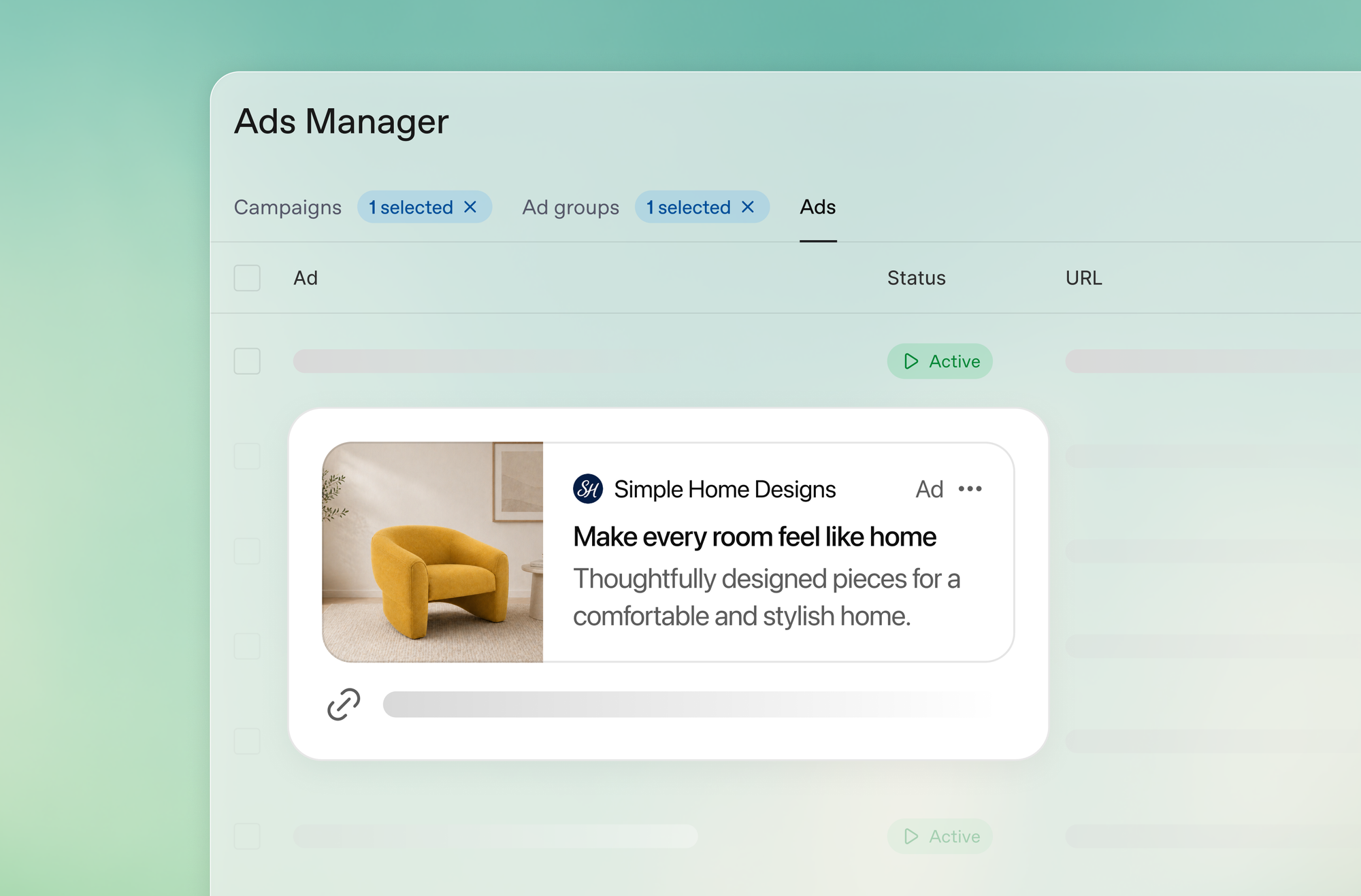
Campaigns pick one of three objectives:
- Views: billed per thousand impressions (CPM).
- Clicks: billed per valid click (CPC).
- Conversions: optimized toward one standard conversion event and billed per valid click (oCPC) or per thousand impressions (oCPM), which is in beta with access still expanding.
The Conversions objective is easy to misread. It steers delivery toward the event you choose, but billing follows clicks or impressions, never conversions. Each campaign supports one standard event, custom events are not supported, and neither the event nor the billing option can be changed after creation. Switching objectives means building a new campaign.
New ad groups that qualify default to a Maximize results bid strategy, in which the system sets and adjusts bids to get as many results as possible from the budget. It does not promise a target cost per click, cost per acquisition or return on ad spend. Advertisers who need a ceiling can switch to Manual: Max bid. For Clicks campaigns, OpenAI suggests starting at a maximum bid of $3 to $5 per click. For conversion campaigns it gives no recommended bid.
A daily budget is a seven-day average, not a daily cap. Spend can reach twice the daily figure on a single day and seven times it across the week, and the budget week runs Sunday to Saturday in the account's time zone. A campaign that uses its weekly allowance early may stop delivering until the next week. A campaign-total budget is the stricter control, but switching from total to daily cannot be reversed.
Minimum daily budgets depend on the account's billing currency. Accounts billed in the currencies of the new markets face floors of IDR 14,000, MYR 5.50, PHP 50, SGD 4.00, THB 33, VND 19,000 and TWD 60, against $25 for US-dollar accounts. Next to the US floor, the Taiwan figure is a small fraction, which makes a low-stakes first test easy to fund.
Billing is postpaid. A card-billed account is charged when unpaid spend reaches an assigned payment threshold, and any balance left at month end is charged then. New accounts typically start with a lower threshold that OpenAI may raise automatically based on payment history, and support does not adjust it. A failed payment can stop delivery. After a campaign is paused, ads can keep appearing for up to 24 hours, and that spend is billable.
Measurement
Conversion tracking needs a data source in Ads Manager and either OpenAI's JavaScript Pixel, the Conversions API or both. A tag manager can deploy the Pixel if it loads the snippet on the right pages and does not block or reorder initialization. Shopify and headless storefronts should send browser events through the Pixel and server events through the Conversions API.
Attribution runs on a click reference called oppref. OpenAI appends it to the landing-page URL, the Pixel stores it in a first-party cookie, and server-side calls should pass it along. When the same conversion arrives through both channels, use one event ID so OpenAI can deduplicate it.
Reporting lags. Impressions, clicks and click-through rate refresh about every 15 minutes, spend can trail by seven to eight hours, and attributed conversions take 24 to 48 hours. Click-through windows can be set to 7, 14 or 30 days and view-through to off or one day, under last-touch attribution. Changing them affects reporting only. Ads Manager totals will not match an advertiser's own analytics, because attribution methods, time zones and consent settings differ.
There is no performance yardstick yet. OpenAI's FAQ says ChatGPT Ads has no benchmarks across advertisers, industries or campaign types. For a product at a $1 billion run rate, that leaves the burden of proof with each advertiser. A first campaign can only be compared with the advertiser's own results on other platforms.
A first test
We would start with one country and one product line. If conversion tracking is live, choose Conversions. If it is not, run Clicks with UTM parameters and add the Pixel at the same time. Use a daily budget first, as OpenAI recommends for new advertisers, and split ad groups by customer need. Write several headline and description pairs per group, each with a different angle. OpenAI's guidance is that a large, varied set of ads lets the system find more relevant conversations. Point landing pages at a specific product, collection or content page instead of the homepage.
Context hints should read as one concrete idea. OpenAI's own example is cushioned everyday running shoes for beginners training for their first 5K. Hints are not targeting rules: they do not guarantee placement in a given conversation and cannot enforce geography or schedules.
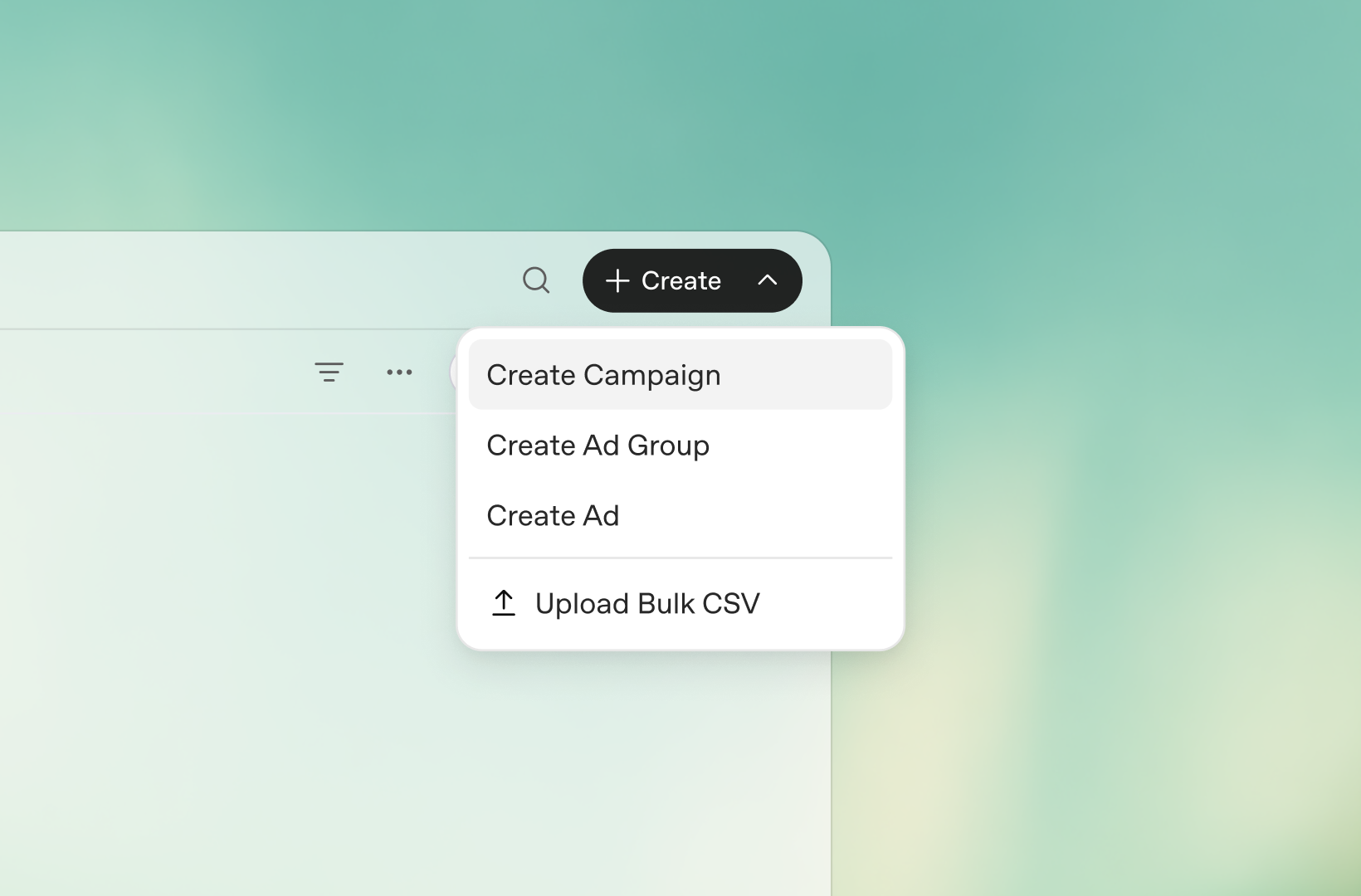
Ads must pass review before they serve. An ad marked Not serving shows a reason on hover, and account review, business verification and billing problems can all stop delivery. The Create menu builds campaigns, ad groups and ads, and it accepts bulk CSV uploads for larger sets.
Frequently asked questions
Can a Taiwanese company open a ChatGPT Ads account on its own?
Yes. OpenAI's Ads Manager availability list marks Taiwan as available for self-service. The legal entity that advertises and is billed must be based in Taiwan, and billing has to be set up before ads run.
What is the minimum daily budget in Taiwan?
NT$60 for accounts billed in New Taiwan dollars. Because the daily budget is a seven-day average, spend on a single day can reach twice that.
Do ChatGPT Plus subscribers see ads?
No. Ads appear only on the Free and Go plans, and Free users can also switch to an ad-free mode.
Does the Conversions objective charge per conversion?
No. It optimizes toward a chosen event but bills per valid click (oCPC) or per thousand impressions (oCPM), and oCPM is still in beta.
Can financial, healthcare or legal advertisers run ads in Taiwan?
Generally not. OpenAI's policy prohibits these categories outside the United States, with case-by-case exceptions limited to the US. Products without medical claims, such as general wellness goods, may be allowed after review.
Sources
- OpenAI: ChatGPT Ads expands to Southeast Asia and Taiwan
- OpenAI: Ad policies
- OpenAI Help Center: Ads in ChatGPT: The Basics
- OpenAI Help Center: Ads Manager Availability
- OpenAI Help Center: Ads Manager Account Setup
- OpenAI Help Center: Billing & Payment
- OpenAI Help Center: Create Campaigns for ChatGPT Ads
- OpenAI Help Center: Conversion-optimized Campaigns
- OpenAI Help Center: Maximize Results Bid Strategy
- OpenAI Help Center: Measure Results
- OpenAI Help Center: Advertiser Guidance for Allowing OpenAI Web Crawlers
- OpenAI Help Center: ChatGPT Ads Frequently asked questions
- OpenAI Help Center: Ads in ChatGPT (user FAQ)
Author Insight
For Taiwanese brands the first job is compliance, not budget. Check that your category is allowed and that OAI-AdsBot can reach your landing pages, because an ad the system cannot review never runs. OpenAI's own FAQ admits there are no performance benchmarks, which means the first advertisers in Taiwan are setting the reference points for their industries. I would treat the first campaign as a measurement exercise: confirm that Pixel events, conversion definitions and reporting lags line up, then decide whether ChatGPT deserves budget taken from existing channels.